Diesel climbs to Rs398.07 as petrol falls to Rs376.06 - what daily fuel pricing means for your business
Petrol is Rs3.19 cheaper and diesel Rs2.25 dearer from 28 October. Here is why they moved apart, how daily pricing works and what it costs transporters.
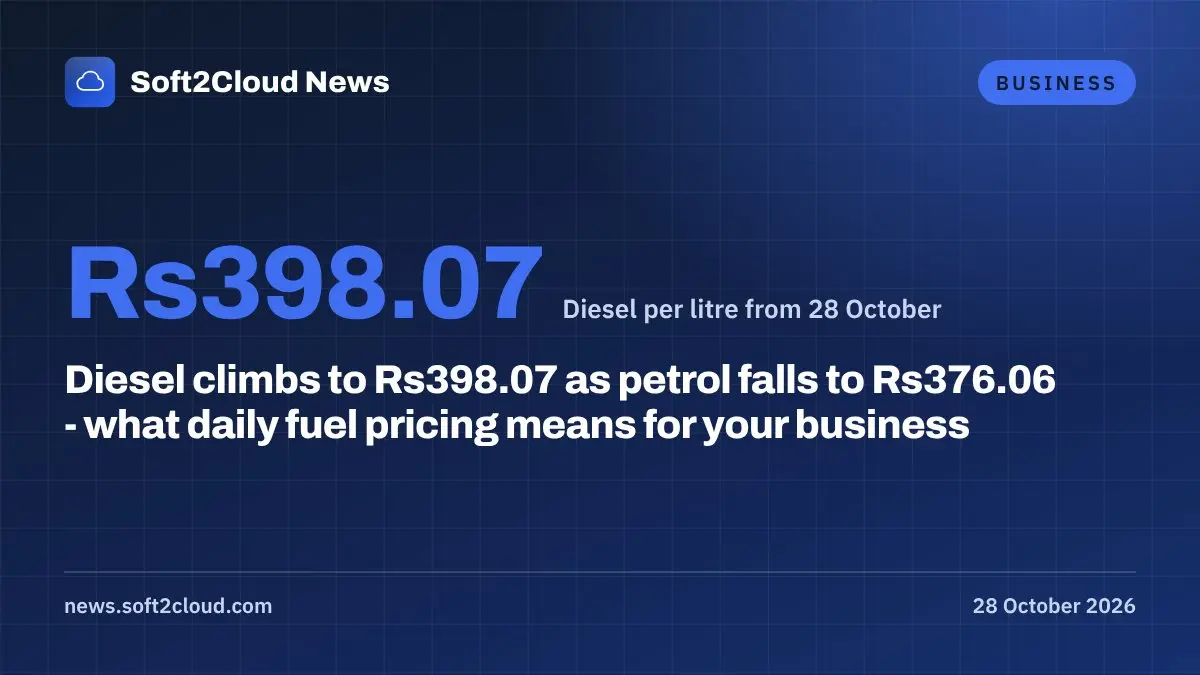
From Wednesday, 28 October 2026, petrol costs Rs376.06 a litre, down Rs3.19, while high-speed diesel costs Rs398.07, up Rs2.25. The two fuels moved in opposite directions, and diesel is now less than Rs2 away from the Rs400 mark.
For a car owner the change is small. For a goods transporter, a tractor owner or a factory running a diesel generator, the steady climb in diesel adds up every week.
The new prices
| Fuel | Old price | New price | Change |
|---|---|---|---|
| Petrol | Rs379.25 | Rs376.06 | -Rs3.19 |
| High-speed diesel | Rs395.82 | Rs398.07 | +Rs2.25 |
The prices were notified by the Petroleum Division after the Oil and Gas Regulatory Authority (OGRA) worked them out under the federal pricing formula.
Why petrol fell while its global price rose
This is the surprising part. According to Business Recorder, the international benchmark for petrol actually rose to $120.21 a barrel from $118.41. Diesel's benchmark went up to $113.13 from $110.58.
Petrol still became cheaper because the government cut the customs duty on petrol by Rs5.71 a litre, to Rs20.56 from Rs26.27. That cut more than offset the higher import cost. Diesel received no such relief, so its higher import cost passed straight through to the pump.
The other parts of the price did not change:
- Petroleum levy: Rs80 a litre on both fuels
- Climate support levy: Rs5 a litre
- Dealer margin: Rs9.98 a litre
- Oil marketing company margin: Rs7.87 a litre
Prices now change almost every day
Since the Middle East crisis began, fuel prices are being set daily, and they stay unchanged on Saturdays and Sundays, Aaj News reported. Since 17 July, petrol has been cut 30 times and raised 38 times. Diesel has been cut 26 times and raised 42 times.
A short look back shows the direction for diesel:
| Period | Petrol | Diesel |
|---|---|---|
| 17 to 19 October | Rs377.71 | Rs393.66 |
| 27 October | Rs379.25 | Rs395.82 |
| 28 October | Rs376.06 | Rs398.07 |
In about ten days, diesel has gone up by Rs4.41 a litre, while petrol is Rs1.65 cheaper.
What it costs: worked examples
These are illustrations based on the old and new prices, not actual bills.
| User | Monthly or trip fuel | Cost at old price | Cost at new price | Difference |
|---|---|---|---|---|
| Car using 50 litres of petrol a month | 50 litres | Rs18,962 | Rs18,803 | Rs160 saved |
| Truck on a 500 km trip at 4 km a litre | 125 litres diesel | Rs49,478 | Rs49,759 | Rs281 more |
| Small fleet using 1,000 litres diesel a month | 1,000 litres | Rs395,820 | Rs398,070 | Rs2,250 more |
| Factory generators using 3,000 litres a month | 3,000 litres | Rs1,187,460 | Rs1,194,210 | Rs6,750 more |
One day's change looks minor. But because prices are reset almost every working day, a business that quotes fixed delivery or freight charges for a whole month can lose its margin without noticing.
What businesses can do now
- Check the price before you quote. If you give freight or delivery rates, link them to the fuel price on the day of dispatch, or add a clear fuel clause to your quotation.
- Track fuel as a separate cost line. Keep a simple log of litres and rupees per vehicle or generator, so you can see the real effect each week.
- Plan routes and loads. Fewer half-empty trips save more than any single price change.
- Review your selling price. If diesel is a big part of your cost, recalculate your margin at Rs398 and at Rs400 so you are not caught off guard.
- Watch oil news. Brent crude was about $114.81 a barrel on Tuesday morning. Pakistan's daily prices follow these moves closely, so a calmer oil market would be the first sign of relief.
Sources
- Business Recorder - Petrol price cut by Rs3.19, HSD hiked by Rs2.25
- Aaj News - Govt cuts petrol price, raises diesel for October 28
- ARY News - OGRA revises petrol price, increases diesel rate
We check every story against the sources above and write it in our own words. Spotted a mistake? Tell us.